Business owners ask for websites in the open, every day. Scoutline is built for the person who wants to answer at volume — and to stay on the right side of the line doing it.
Not a market we have to argue exists. Four public groups, whose entire purpose is finding somebody to build a website, hold more than 175,000 members between them.
“I need a website for my business. Is there anyone who can walk me through it?”
“Looking for someone local to design me a site. I’m absolutely rubbish at these things.”
“Need a website designer — message me with a quote, please.”
“Tried building it myself and couldn’t figure it out.”
“Who does business websites? Need it done asap.”
“Looking to revamp my website — anyone local?”
These six are recreations, not screenshots. The wording is representative of real public posts collected on 3 August 2026; no post is reproduced word for word, and every name, avatar and business has been left out. The counted figures above are group and post totals as at the same date and will have moved since.
The demand is visible to everybody. The ability to answer it repeatedly is not.
Trawl the map, open each business, work out which ones are worth pitching, build something per prospect, write a pitch per prospect. That is why the honest posts from people doing this work are about the grind: one about 87 cold calls for a single booked meeting drew 19,100 likes, and “cold calling drains me” drew 30,500.
Lead-list scrapers hand you a spreadsheet and stop. Site builders start once you already have a client. Fully autonomous agents do the lot but take the person out of the loop entirely, which is a different product with different liabilities.
Finding a business and building its site are two jobs. Doing both, for many businesses, in a way one person can actually supervise, is where the evening goes — and it is the part almost nothing on the market does.
Engagement figures are from public posts, counted 3 August 2026.
A single site is a favour. A repeatable pipeline is a business — so every step is built to run in batches, and the monthly quantities are measured in dozens, not ones.
One search covers a whole area across 289 professions, and every business found is scored on how worth pitching it is — not looked up one at a time. Up to 100 businesses a month on the entry plan, 500 on the top one.
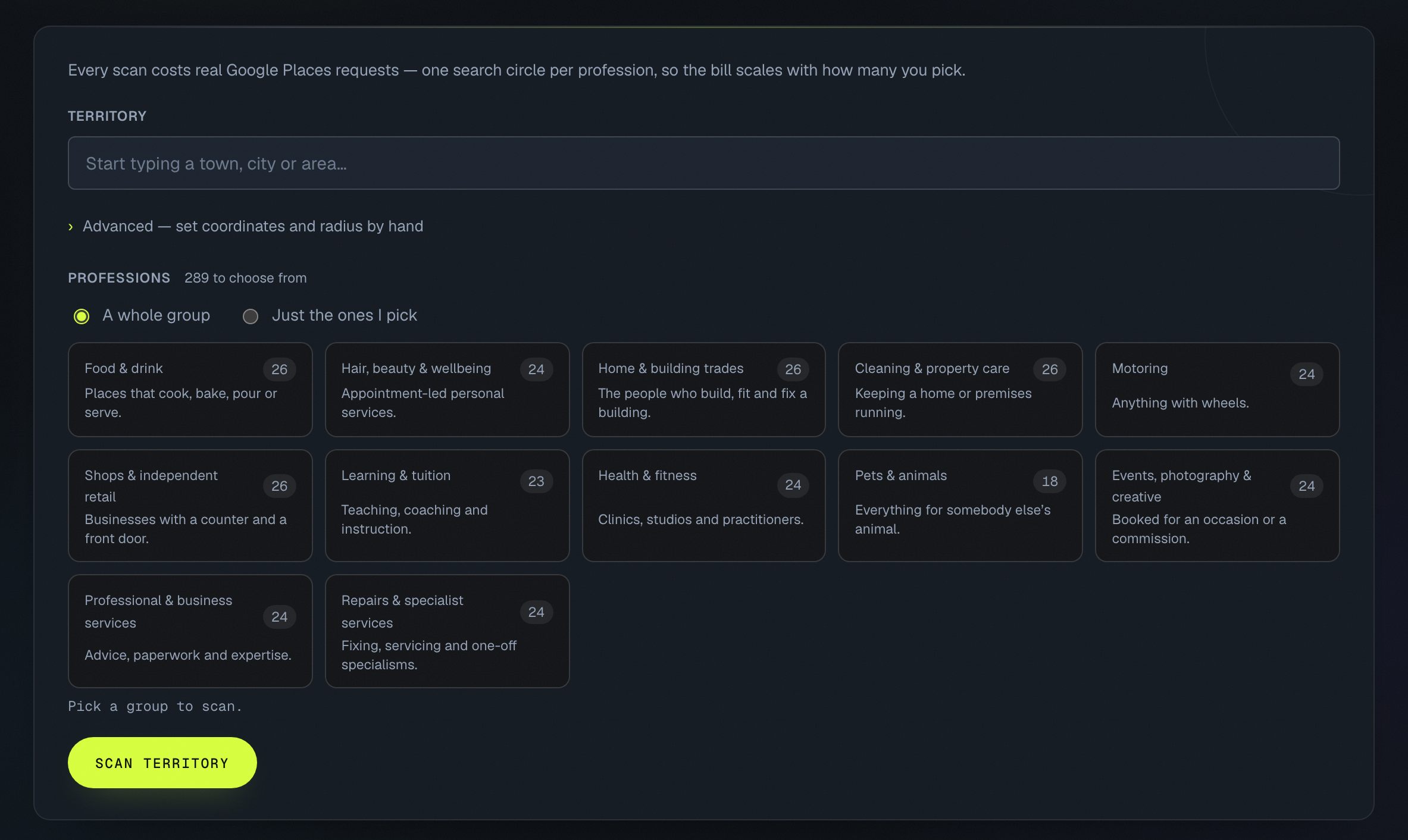
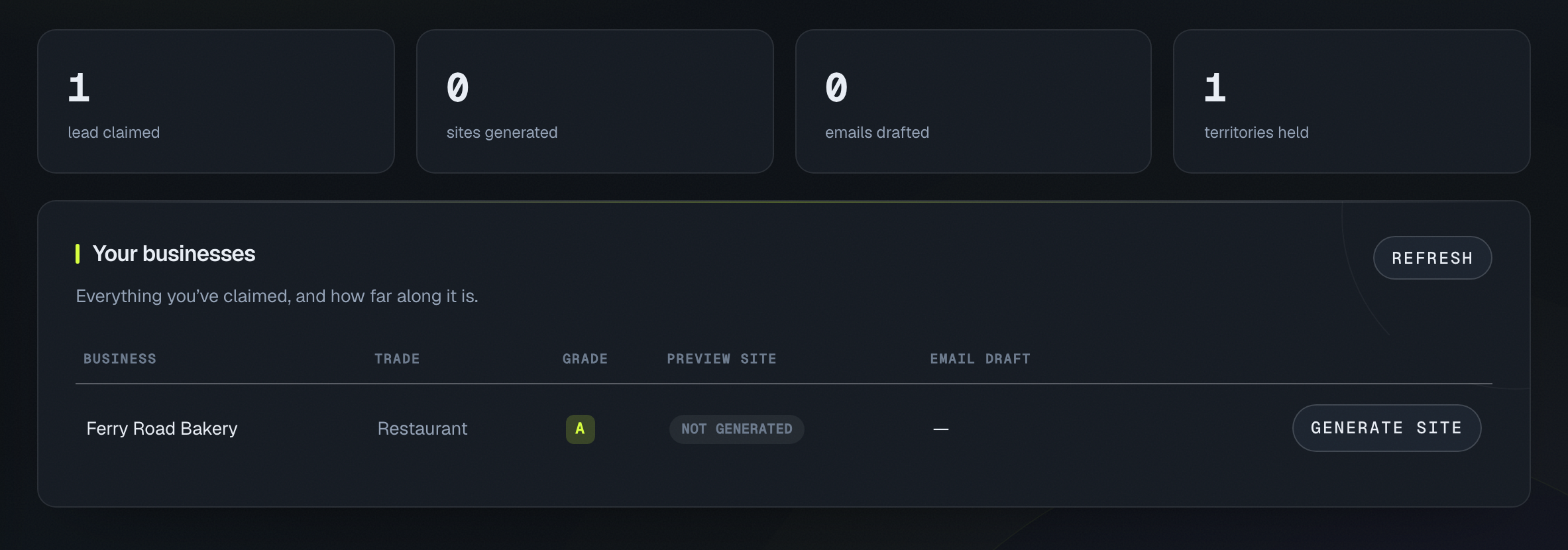
Take a batch of the best-scoring leads in one action and they are locked to you. 40 a month on the entry plan, 200 on the top one — and on the two upper plans you can lock a whole area so nobody else using Scoutline can touch it.
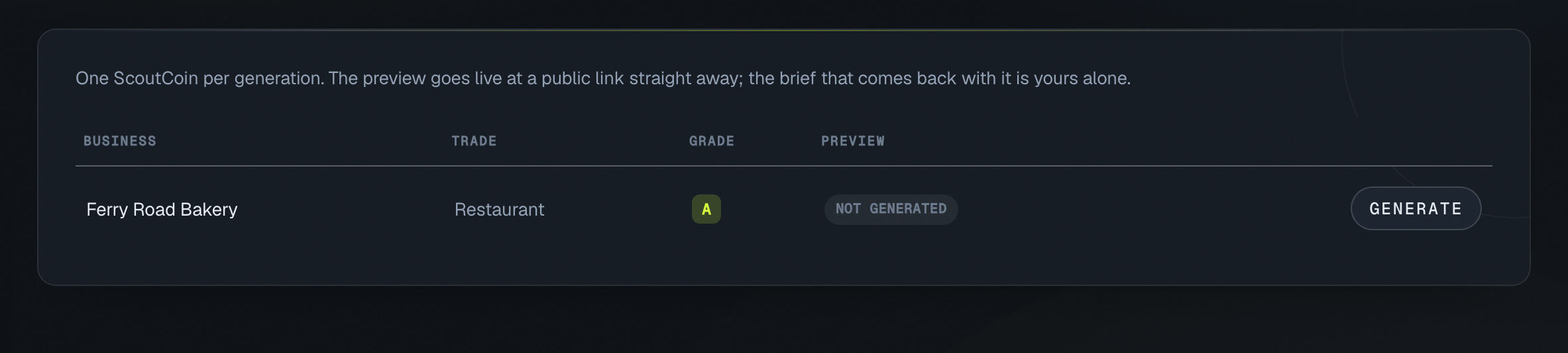
A real, finished-looking one-page site per lead, built from that business’s own facts. 20 ScoutCoins a month on the entry plan, 100 on the top one — one coin is one preview.
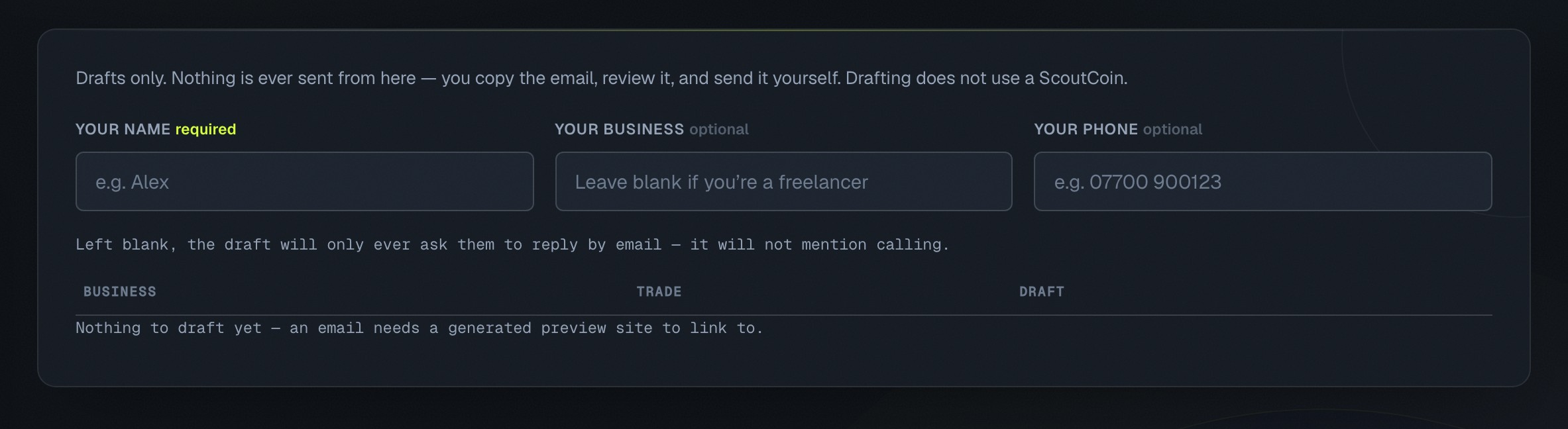
An outreach email written against that specific business, with a link to its preview. Drafting costs no coins. It is a draft — you send it, or you do not.
The full multi-page site, its stylesheet, a hand-written script, your customer’s own photographs and a handoff pack — zipped in the browser. A full site costs 3 ScoutCoins.
Screenshots are the current interface. Allowance figures are the real monthly limits on the Solo Operator and Full-time plans — see pricing for all three.
A claimed lead is yours, enforced in the database rather than by policy. On the upper plans you can lock a whole area exclusively. Tools sold as a one-off cannot offer this: every buyer is scanning the same map data with no coordination between them, so the same shop gets the same pitch from five different people in the same week.
Five real screens, live allowance figures, a lead table and progress you can watch — shown above rather than claimed. It matters beyond convenience: an agent that publishes and sends on its own means you never see what went out in your name.
This is a legal position, not a missing feature. In the UK, sending unsolicited email to businesses at scale engages PECR, and “the software did it” is not a defence — the sender is liable. So we write the draft and a compliance checklist, and a person sends it. The reason we stop one step short is the reason you can run this here at all.
A generated site may not invent a service, a price, a qualification, a founding date or a review. Anything unknown becomes a visible placeholder plus a line in your private brief. A tool that scrapes a business and builds unsupervised will eventually state something untrue about a real business — and the owner reads it before you do.
Categories of tool, not particular products. Written to stay true without us monitoring anyone.
| Lead-list scrapers | AI site builders | Autonomous agents | Scoutline | |
|---|---|---|---|---|
| Finds businesses for you | Yes | No | Yes | Yes |
| Builds the site | No | Yes | Yes | Yes |
| Writes the approach | No | No | Yes | Drafts it |
| Sends it for you | No | No | Often | Never, by design |
| A person reviews before anything moves | — | — | Not necessarily | Always |
| Area exclusivity between customers | No | No | No | On upper plans |
| Constrained from inventing facts | — | Varies | Varies | Yes, by construction |
| Uses the owner’s photos without asking | — | Varies | Sometimes | Never uploaded at all |
Each of these is a decision, and each one costs us a feature somebody else advertises.
No SMTP, no sending code anywhere in the product. You send, from your own address, having read it.
A preview is hosted on a private link so you can show it. Nothing of ours goes onto the open web under a business’s name.
They are read in your browser and packaged there. They never reach our servers, so we are never holding somebody else’s pictures.
We have no earnings claim to make and will not invent one. What is on this page is demand and mechanics; what you make of it is your work.
A preview site is a first impression sent to a stranger. Scoutline’s generators are hard-constrained to use only real facts — anything unknown becomes a flagged placeholder plus a line in your private brief, never a confident-sounding invention. That is what makes the pitch safe to send.